Filtering facepieces with protection class FFP2
Let's discover more about BLS FFP2 filtering facepieces without valve

What are they?
BLS filtering facepieces without valve featuring FFP2 protection are suitable for protecting both the user and the environment from particulates and have a minimum filtering efficiency of 94%.
The protection of these devices provides a barrier on exhalation, protecting the environment from the user. They are therefore ideal in the food industry and in all working environments where contamination by the user must be avoided.
Which are the main BLS models?
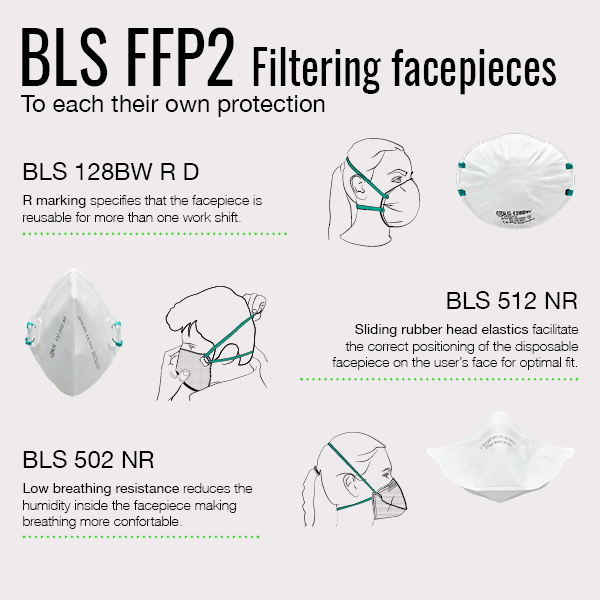
 BLS 128 BW R D is a cup filtering facepiece from the BLS Classic series that is classified as reusable (R), i.e. it guarantees filtering effectiveness beyond one working shift. Head elastics ensure maximum comfort during use, as does the soft nose gasket.
This model has also passed the Dolomite test (D), which guarantees complete protection for more than 8 hours.
Find out more
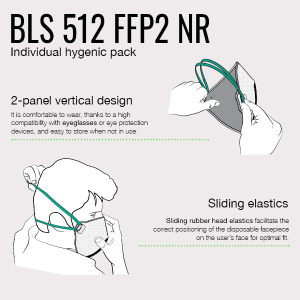
BLS 512 NR is a vertical filtering facepiece with sliding head elastics, which facilitate the positioning of the device on user's face for an optimal fit.
The flat design prevents contamination of the inside before and after use: ideal for intermittent usage as it does not spoil in the pocket.
It is distributed in individual packs, protecting the user from contamination before use.
Find out more
BLS 502 NR is a duck shaped filtering facepiece, which features a low breathing resistance because by reducing the humidity inside the device it facilitates breathing. The flat design adapts to different face types and is easy to store before and after use, without spoiling in the pocket. It is distributed in single packs, protecting the user from contamination before use. BLS 502 PPE/MD model is certified as a type IIR non-sterile disposable facial mask, according to UNI EN14683, and classified as a Class 1 Medical Device, according to Regulation (EU) 2017/745.
Find out more
BLS devices are manufactured from high quality raw materials, allowing them to be stored for up to 10 years, and are CE certified according to EN 149:2001+A1:2009.


 BLS 128 BW R D is a cup filtering facepiece from the BLS Classic series that is classified as reusable (R), i.e. it guarantees filtering effectiveness beyond one working shift. Head elastics ensure maximum comfort during use, as does the soft nose gasket.