Scopri gli eventi BLS di questo mese
24-27 ottobre
A+A 2023
Düsseldorf, Germania
stand n. 9B32


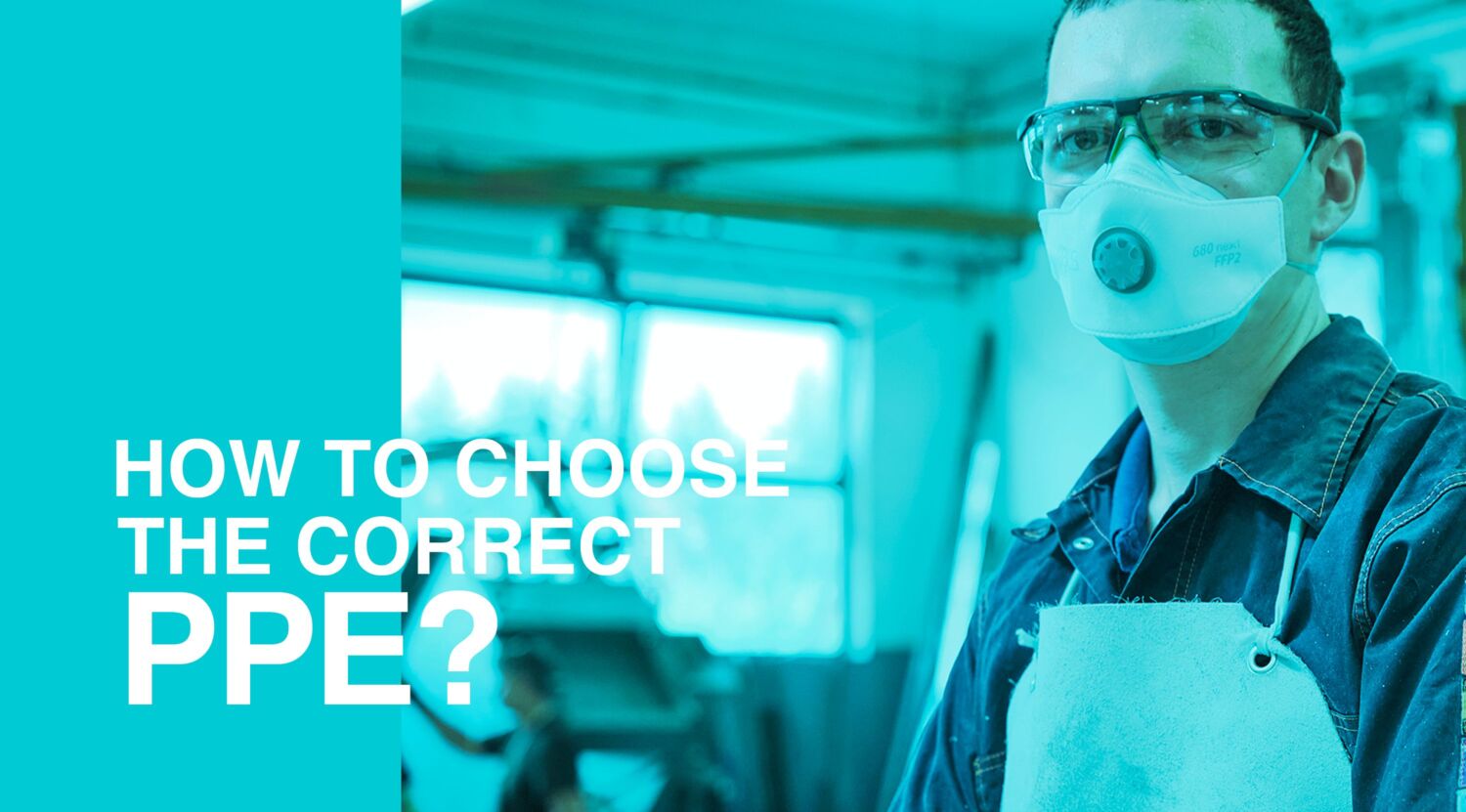
The law demands the use of PPE whenever there is a so-called 'residual risk', i.e. the risk that remains after the prevention and protection measures taken by the employer have been implemented.
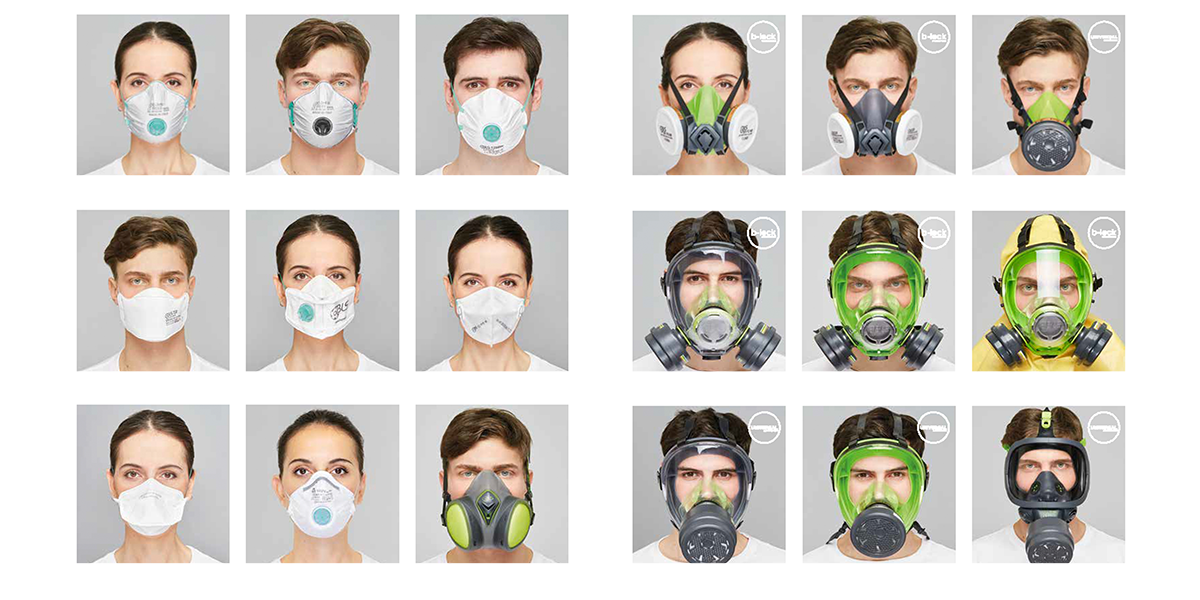
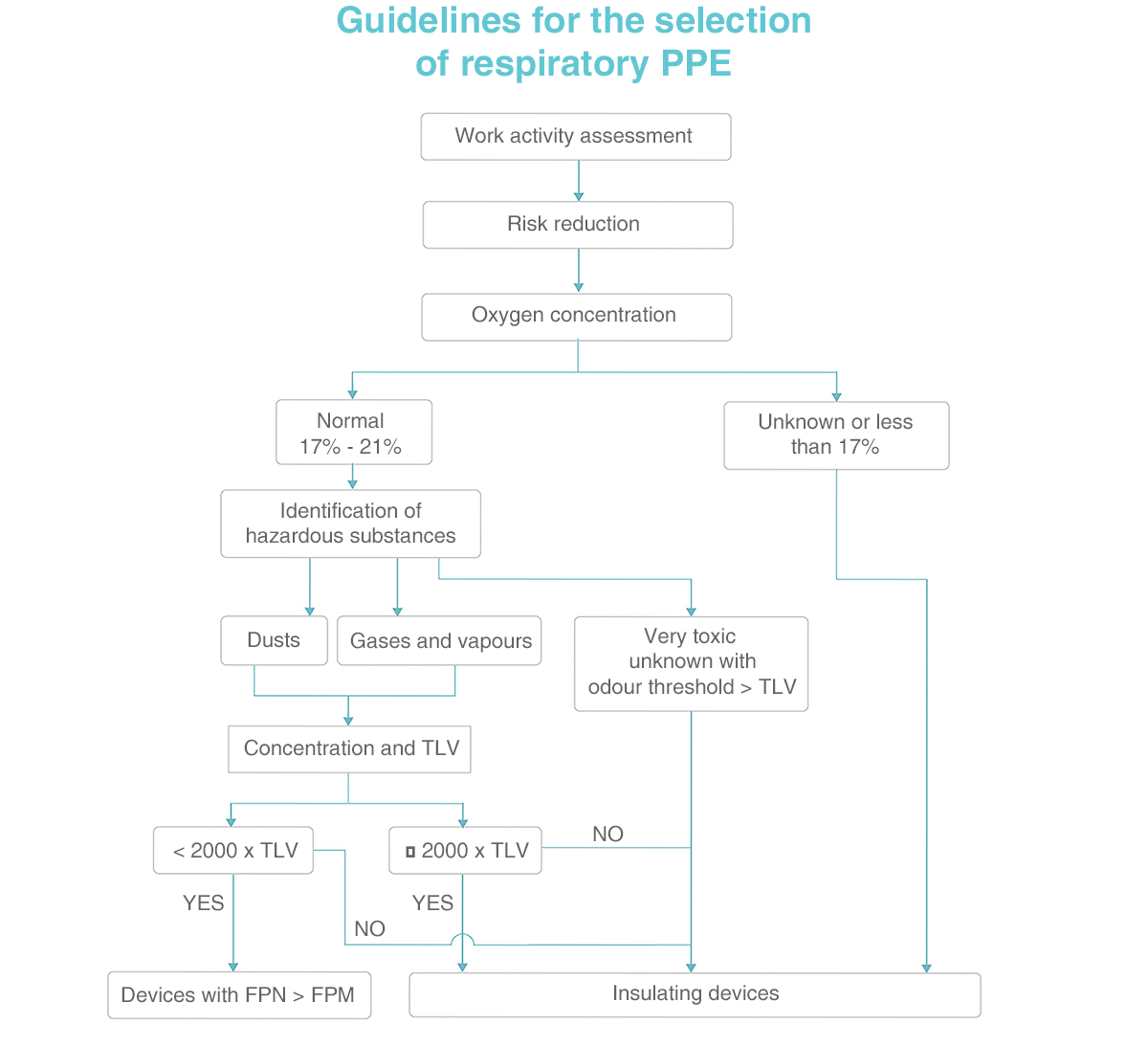
When selecting respiratory protection, an effective programme must be implemented, which can be categorised into the following steps:
- Identification of oxygen quantities for the entire duration of exposure;
- Identification of the chemical nature of the hazardous substances and their effects on humans and any synergistic effects;
- Identification of the physical state of contaminants in the air (dusts, mists, fumes, gases, vapours);
- Identification of the highest concentrations of hazardous substances during the exposure period;
- Identification of the odour threshold of hazardous substances;
- Identification of the permitted occupational exposure limit values (TLVs - Threshold Limit Value**), if any;
- Identification of collateral hazards, associated with the work/production process that may affect the choice of respiratory protective equipment (e.g. splash, flammability or eye hazard, etc.);
- Identification of the Minimum Protection Factor (FPM) required in the workplace, which can be defined as the ratio between the worst possible concentration of the contaminant(s) in the air and the maximum allowable concentration inside a respiratory protective device, which is the occupational exposure limit value. FPM = (Contaminant Concentration)/(Contaminant TLV);
- Identification of the device with a protection factor higher than the minimum required protection factor.
Once the above checks have been carried out, it is possible to follow a guideline scheme for choosing the most appropriate protective equipment (general values indicated in EN 529:2005).
Nominal protection factor (NPF**) of devices:
| FPN | BLS DEVICES | ||
| Dust | Gases and Vapours | Combined | |
| 4 | FFP1 | - | - |
| 12 | FFP2 | - | Half mask with integrated filters-GasX-P2 Half mask-GasX-P2 |
| 16 | - | - | - |
| 33 | - | - | Half mask with integrated filters-GasX-P3 |
| 48 | Half mask-P3 | - | Half mask-GasX-P3 |
| 50 | FFP3 | Half mask-GasX | - |
| 1000 | Full face mask-P3 | - | Full face mask-GasX-P3 |
| 2000 | PAPR-TM3 | Full face mask-GasX | - |
* TLV: Threshold Limit Value –limit of the time-weighted average concentration of hazardous substances in the air, within the breathing zone of a worker, with respect to a specified reference period.
** NPF: Nominal protection factor – guideline value obtained through laboratory tests. In order to assess the expected protection in the workplace, it is necessary to adopt the Assigned Protection Factors (APFs) relevant to the country of reference (EN 529:2005).

Scopri gli eventi BLS di questo mese
24-27 ottobre
A+A 2023
Düsseldorf, Germania
stand n. 9B32

Scopri gli eventi BLS di questo mese
24-27 ottobre
A+A 2023
Düsseldorf, Germania
stand n. 9B32
Scopri tutti gli eventi 2022 di BLS Il 2022 è stato un anno ricchissimo di eventi. Tutto il team BLS ha lavorato instancabilmente per partecipare a numerose fiere di settore e crescere in termini di tecnologia e sicurezza. In totale BLS ha partecipato a 12 fiere internazionali in 7 Paesi diversi: in Spagna, Italia, Inghilterra, Polonia, Francia, […]