Nanofiltration: protection against nanoparticles
Why is protection against nanoparticles so important?
One of the main features of some BLS products is nanofiltration, which refers to the filtering facepiece’s ability to filter nanoparticles.
But what are nanoparticles, and why is it important to protect ourselves against them?
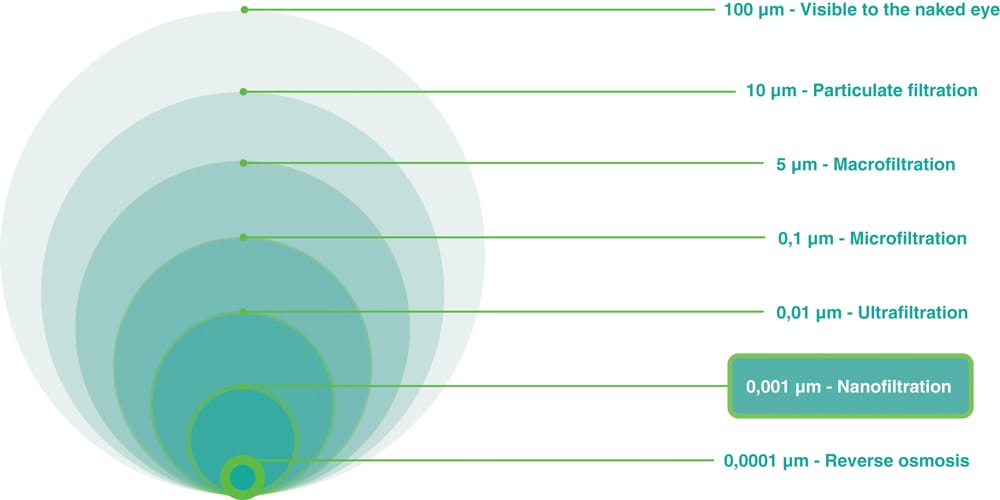
Nanoparticles are particles with a diameter generally ranging from 1 to 100 nm (0.001 μm to 0.1 μm).
Recent studies have shown that some nanoparticles can penetrate cells and tissues, travel through the body and brain, and cause biochemical damage. In particular, the extremely small size of nanopowders gives them behaviour that can be described as intermediate between that of gases and that of other suspended particles. Adequate protection is therefore essential.

For reference, the EN 149 standard requires filtering facepieces to be tested using particles with an average size of 0.4 μm. Nanofiltration therefore refers to significantly more demanding performance requirements than those established by the standard.

Let’s take a closer look at nanoparticles
What are they, how do they behave, and where are they found?
First of all, it should be noted that nanoparticles used in nanotechnology have beneficial applications, as they are handled under strictly controlled conditions.
Particles dispersed into the environment and released in an uncontrolled manner are very different in nature and potential hazard. Examples include particles generated by urban pollution or combustion processes.
Nanoparticles may be present in many industrial processes, including welding, grinding, sanding, metal cutting, injection and moulding processes, roadworks, sieving and sandblasting.
Essentially, wherever particles are generated, nanoparticles may also be produced, as demonstrated by several studies on the subject.
EPI4Nano Project
In 2021 and 2022, BLS promoted the EPI4Nano Project, developed by the ITENE research institute in Valencia to validate specific products designed to provide effective respiratory protection against nanoparticles.
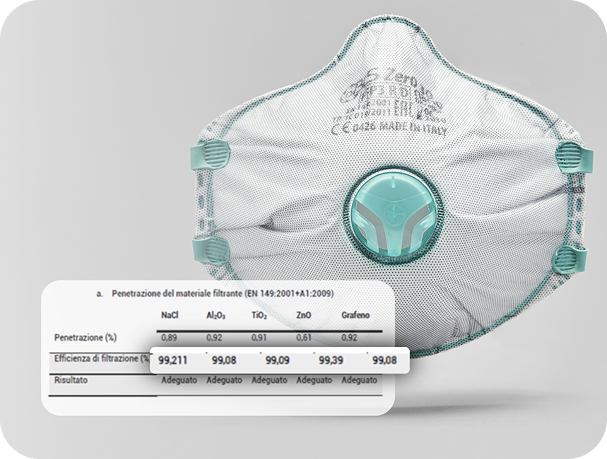
BLS Zer0 range of filtering facepieces was tested for filtration efficiency against copper and zinc oxide nanoparticles. The tests confirmed that these products can filter more than 99% of these nanoparticles.

Which BLS products feature nanofiltration?
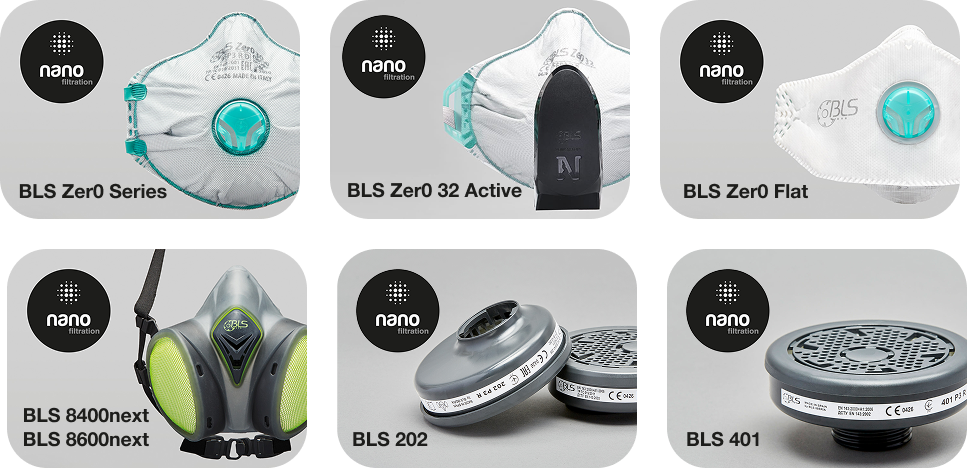
The same filtration performance—over 99% of these nanoparticles—is provided not only by our BLS Zer0 and BLS Zer0 Flat filtering facepiece ranges, but also by the BLS 8000next half mask with integrated filters, the b-lock series particle filters with bayonet connection, and the DIN series filters with universal connection.
Specifically: