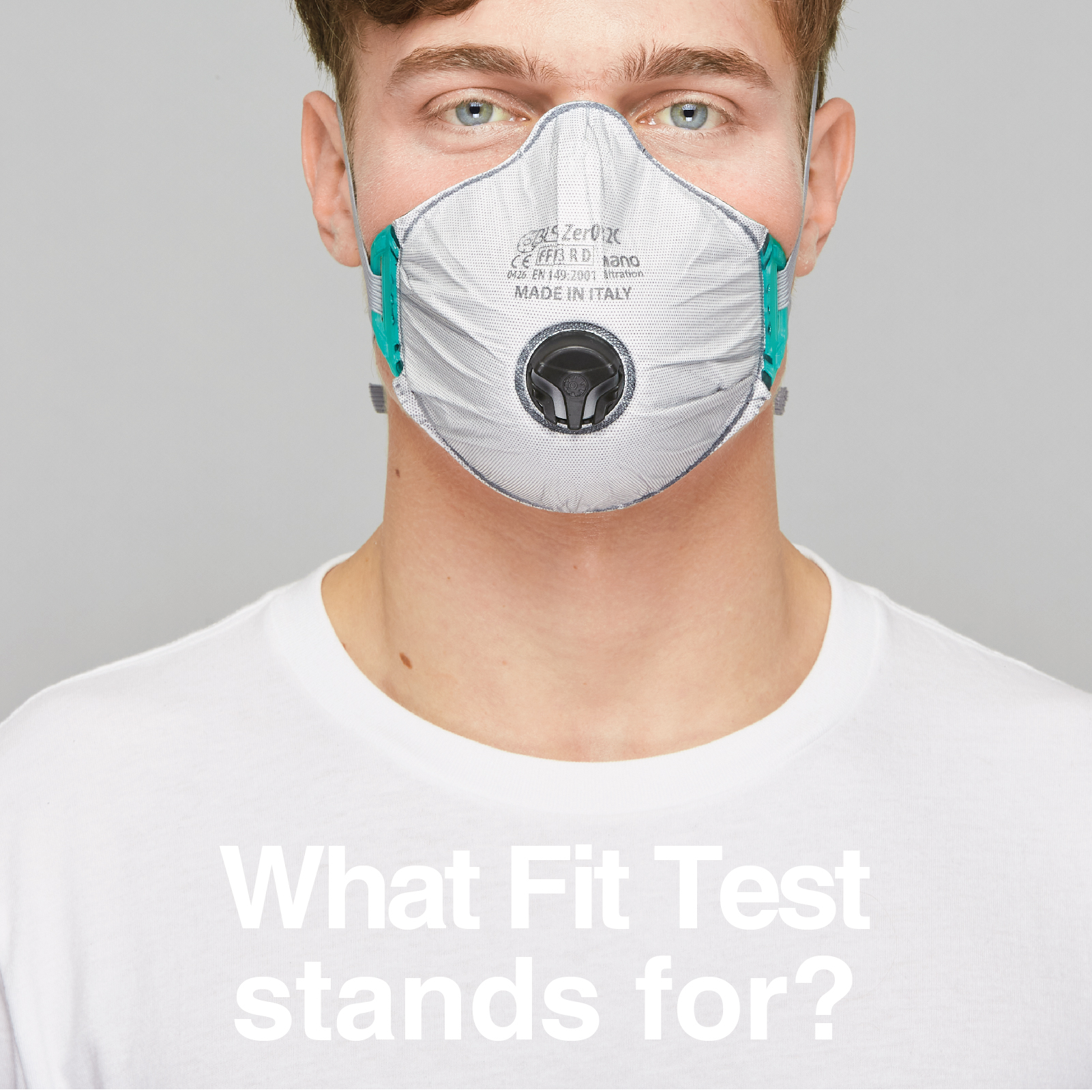
A Fit Test is a method of evaluation of the efficiency of a respiratory protective device in terms of its fit to the user's face.
Why conduct a Fit Test?
Although more attention has been paid to health in the workplace in recent years, incorrect use or inappropriate selection of airway protective equipment is still a common problem.

With the Fit Test, it is possible to determine if there is a leak in the face seal.
This is a key step in the certification of respiratory protective equipment, and is important for equipment used in workplaces where toxic substances are released into the air.
A Fit Test can be of a qualitative or quantitative nature.
Qualitative Fit Test
A qualitative Fit Test has a non-numerical outcome, positive or negative, based on the user's response to any possible leakage. During the assessment, the user's senses, such as taste and smell, are used as benchmarks.
It takes place in two distinct phases: the 'sensitivity test' and the 'leakage test'.
(I) SENSITIVITY TEST
The user wears the hood with visor. The function of the hood is to delimit a specific volume of air around the user's head in order to check the concentration of aerosol in the air inhaled. The purpose of the sensitivity test is to determine whether the individual being tested is able to recognise the taste of saccharin. If the tester is unable to perceive the substance, the results obtained are considered unreliable.
The technician performing the test inserts the nebulizer into the hole provided on the viewer and starts to vaporize the type A aerosol inside the cap by performing 10 sprays.
The user has to breathe with the mouth open and tongue extended and tell the technician whether or not he/she perceives the saccharin aroma. If the user perceives the saccharin taste within 10 sprays the sensitivity test can be considered completed and 10 will be the user's threshold value.
If the user did not perceive the saccharine taste, the technician must perform another 10 sprays. If the user perceives the sweet taste of saccharin between 11 and 20 sprays the sensitivity test can be considered completed and 20 will be the user-specific threshold value.
In case the user did not perceive it, the technician will have to perform another 10 sprays. If the user perceives the sweet taste of saccharin between 21 and 30 sprays the sensitivity test can be considered completed and 30 will be the user-specific threshold value.
If the user does not perceive the nebulised substance even after 30 sprays, he must be considered unsuitable for this type of test.
(II) FIT TEST
The leak test should only be carried out after the user has correctly donned the protective equipment (according to the manufacturer's instructions). During the test, the user shall be asked to perform exercises that simulate common movements made during the use of the respiratory protective device.
The user shall place the hood with visor on his/her head after putting on the protective equipment to be tested.
The test technician inserts the nebuliser into the hole in the visor and starts to spray the type B aerosol into the hood, spraying a number of times equal to the threshold value obtained from the sensitivity test. After the first series of sprays, every 30 seconds, he will perform a number of sprays equal to half of the established threshold value.
The user starts by carrying out seven exercises, each lasting one minute: breathing normally; breathing deeply; turning the head to the right and left; bending the head up and down; speaking out loud; bending the torso forward; breathing normally.
If in any of the seven exercises the user perceives solution B despite wearing the protective device, the test should be considered as completed with a negative result. This means that the device has not been worn correctly or is not suitable for the size or shape of the user's face.
If the user does NOT perceive the substance being sprayed the test can be considered as completed successfully. This means that the device ensures correct protection of the respiratory tract.
Which devices should be tested?
The Qualitative Leak Test is suitable for the evaluation of disposable filtering facepieces of classes FFP1, FFP2 and FFP3 and negative pressure half masks. The test is not suitable for the evaluation of full face masks or positive pressure devices.
Riferimenti normativi
Il test di tenuta qualitativo BLS è stato realizzato seguendo le direttive dell’Health and Safety Executive (HSE) e dell’Occupational Safety & Health Administration (OSHA) che hanno emesso delle specifiche procedure per lo svolgimento del Test (rispettivamente la normativa HSE OC 282/28 e la normativa 1910.134 App A).