Do you know the differences between FFP2 and FFP3 masks?
Filtering Face Pieces (FFP) protect against the so-called "particulates", which commonly identify different types of particles occurring in the air: dusts, mists and fumes. In this type of products, the level of protection is defined based on three different categories of minimum filtering efficiency: FFP1, FFP2, FFP3.
So what are the factors for choosing a facepiece over another one?
It all depends on the risk assessment of a given environmental context, which is determined by the threshold limit value (TLV): this factor identifies the limit value of airborne chemicals above which - if regularly exposed - a worker is expected to suffer adverse health effects.

TLV is therefore essential in defining the maximum level of harmful particles that PPE can filter from the outside: it is defined that a class FFP2 can protect against a maximum concentration of 12 x TLV, while an FFP3 protects up to 50 x TLV.
Based on these standards, it is stated that an FFP2 mask has up to 94% minimum filtering efficiency, while an FFP3 has up to 99% effectiveness, but it should be noted that the right protective device can ultimately be selected depending on the assessment of the environmental risk, and therefore on the concentration of the pollutant involved.
So, how do these distinctions work?
An increasing level of protection also implies a higher respiratory resistance for the user: this causes fatigue, which depends on the environmental temperature, on the physical activity carried out and on the length of time the device is worn (for a maximum of 8 hours for non-reusable PPE).
How to overcome high respiratory resistance?
Especially for an FFP3 class of protection, it is important that the device is equipped with ventilation support by means of an exhalation valve: this device is the only one that allows the warm moist air inside the mask to be exhaled more easily, ensuring a high level of comfort for the end user.
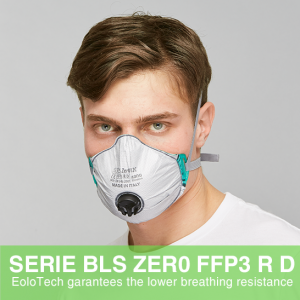
Our BLS Zer0 FFP3 R D series guarantees a maximum protection class with minimum breathing resistance, thanks to its Eolo Technology system which allows an air passage in exhalation 30% higher than traditional valves.

In addition, it is made of a highly breathable filter material with a water vapour transmission ratio (amount of vapour able to pass through it) of 4500 g/sqm*24h: this value is linked to ideal materials to be used during intense activity.
Choose only highquality products.
Your health matters.