Microorganisms
Legislative Decree 81/2008 (Art. 267) defines biological agents as 'any microorganism, even if genetically modified, cell culture and human endoparasite that could cause infection, allergy or intoxication'.
What is meant by 'micro-organisms'?
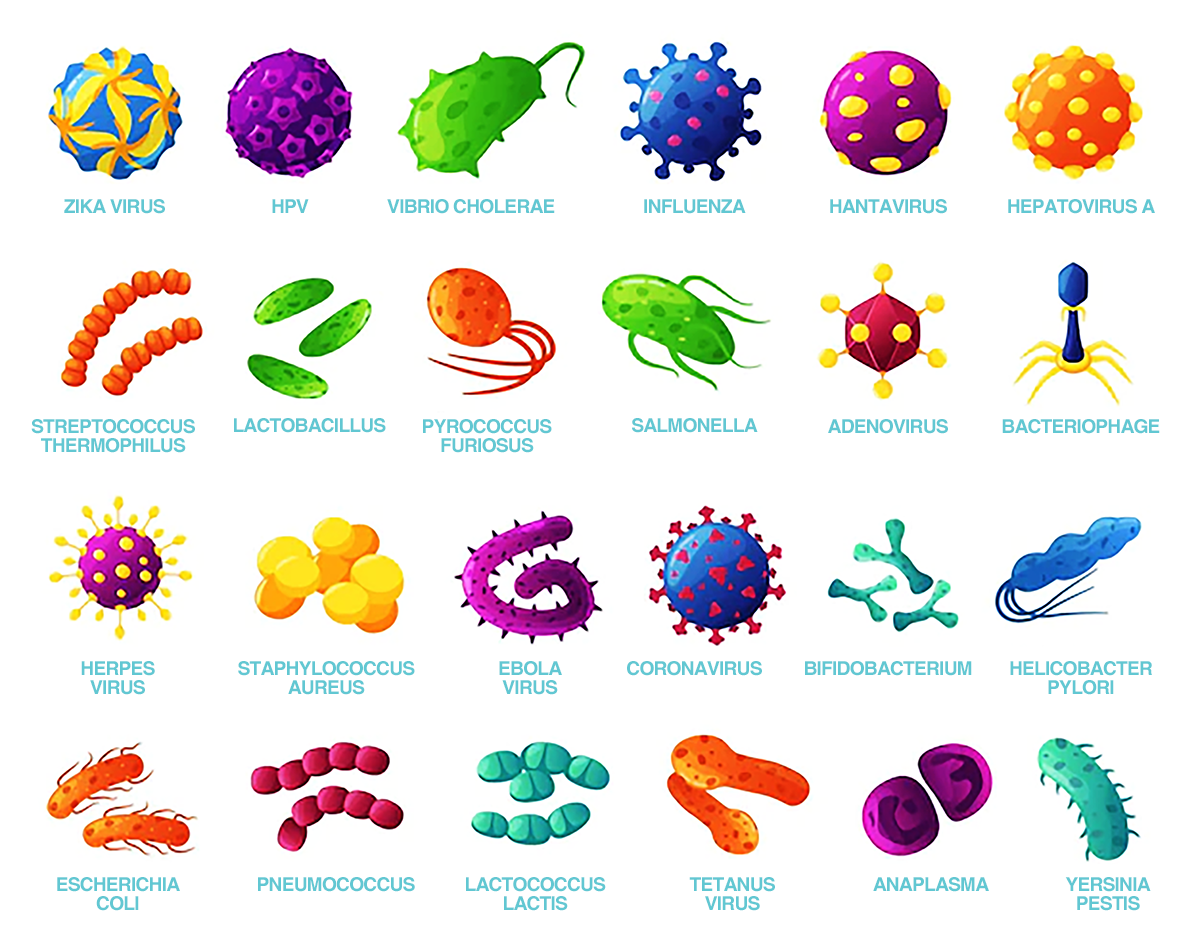
Micro-organisms are 'microbiological entities, cellular or non-cellular, capable of reproducing or transferring genetic material'; micro-organisms are among the biological agents. They are organisms smaller than a millimetre, both eukaryotes (protozoa, fungi) and prokaryotes (bacteria, viruses).
For more information on biological agents read all the dedicated articles on our blog: Biological Agents, Classification of Biological Agents, Biological Agents and Transmissibility.

Pathogenic microorganisms, in particular, are those investigated by medical microbiology as they are responsible for infections and diseases in the human body.
However, if we want to consider biological hazard sources in a broader sense, products of plant or animal origin, multicellular ectoparasites (e.g. ticks, mosquitoes, etc.) and allergens of animal and plant origin (dust mites, animal epidermal derivatives, grain dust, etc.) should also be considered in the risk assessment. This definition therefore also includes parasites.' (Microorganisms - INAIL, 30/11/2012)
What are the main differences between these microbiological entities?
Bacteria and viruses differ first of all in size: 0.001 millimetres versus 0.0000001 millimetres for viruses.
Furthermore, while bacteria are considered living organisms and are self-reproducing, the same is not true of viruses, which require a host to propagate and are not considered living organisms.
The methods of counteracting them are different:
- A bacterial infection is treated with antibiotics but there are no useful vaccines.
- A viral infection is treated with antivirals and can be counteracted by vaccination.

Diseases caused by viruses: colds, influenza, smallpox, measles, chickenpox, hepatitis, papilloma, herpes, poliomyelitis, rabies, Ebola, SARS, AIDS.
Diseases caused by bacteria: cholera, diphtheria, plague, dysentery, tuberculosis and also typhoid.
When pathogens enter the body, they provoke a nonspecific response (which is the same for every pathogen) with the production of substances that call up immune cells that incorporate and kill the pathogens. In order to prevent contagion from pathogenic microorganisms, it is essential to adopt personal measures and periodic sanitisation of environments, as well as to wear PPE (Personal Protective Equipment) correctly.
What are the employer's obligations?
All occupational entities intended to carry out operations involving the use of biological agents - unmodified - of groups 2 or 3 (capable of causing disease) are required to provide communications to the competent territorial supervisory body, including risk assessment documentation:
a. The stages of the work process involving a risk of exposure to biological agents;
b. The number of workers assigned to the stages referred to in point a.
c. The details of the person in charge of the prevention and protection service;
d. The working methods and procedures adopted and the preventive and protective measures applied;
e. The emergency programme for the protection of workers against the risks of exposure to a group 3 or group 4 biological agent, in the event of a defect in physical containment.
Also listed are 7 activities that may involve the presence of biological agents in the workplace, i.e. may involve the risk of exposure while not working directly with them - or 'deliberate use'):
Activities in food industries;
In agriculture;
In which there is contact with animals and/or products of animal origin;
In health services, including isolation and post-mortem units;
In clinical, veterinary and diagnostic laboratories, excluding microbiological diagnostic laboratories;
In facilities for waste disposal and collection of potentially infectious special waste;
In sewage treatment plants.
Microbiological contamination of hospitals and healthcare environments
According to a document published by INAIL, "surfaces play a prominent role in the spread of microorganisms in the nasocomial environment", i.e. in hospital environments.
With regard to microbiological contamination in working environments, a publication indicates that 20/40% of hospital infections are attributable to infections transmitted through healthcare workers' hands and/or gloves.
In addition to the air we breathe, surfaces can also be vehicles for microbiological contamination. In healthcare environments in particular, the role of surfaces in the spread of micro-organisms is prominent: there are certain specific properties of the agents that facilitate their survival in the environment outside the human body.
Stay informed, stay safe.